2026: A Rebuilding Year
I left Aconcagua with big plans for the winter, having joined the Armenian ski mountaineering team and getting ready to race my first World Cup season. Actually, even though Aconcagua turned out to be a great experience, I almost saw going as a chore, something I had committed to earlier. My mind was fully on the SkiMo World Cup season ahead. I even rebooked my flight three days early so that I could get home and be on skis again. I had been out of formal competition for a long time (since “retiring” from cycling in 2017) and felt reinvigorated to come back to elite sport with a more mature approach than I’d had in my 20s and hopefully some remaining metabolic potential in the year I’d turn 40.
I knew that January would be a slow start. Climbing a mountain like Aconcagua and then taking a long flight puts a lot of stress on the body and makes high-intensity race efforts particularly difficult. The World Cup calendar had a break in February for the Winter Olympics, so my plan was to do the first World Cup in Courchevel in January, then race the Belle Étoile stage race with my friend Joe (another one), then do a solid block of training in February, and finish the season strong in March.
The year did not go as planned.
In early February, I caught an edge skiing at around 100 kph. It was the end of a hard training day, and ironically I thought my day was over. I was back on a groomer and just cruising to the car. I picked up speed to get across a long flat section. My left ski wobbled over some undulations, sank into a patch of soft snow, and the rest was ballistics. The whole ordeal was probably less than a second, but I swear I felt each and every millisecond of the experience. I hooked left and saw a wooden post ahead of me. The next thing I remember, I was curled up in the snow gasping for air, skis and poles launched in all directions. My first thought: Guess I will skip the weight training this afternoon. But soon I realized that I could not get up or move my arms, and then the ski patrollers came, and then they recommended calling a helicopter to airlift me to the hospital. In the end, I had dislocated both shoulders, fractured my left scapula, and suffered heavy contusions and/or fractures through my whole rib cage.
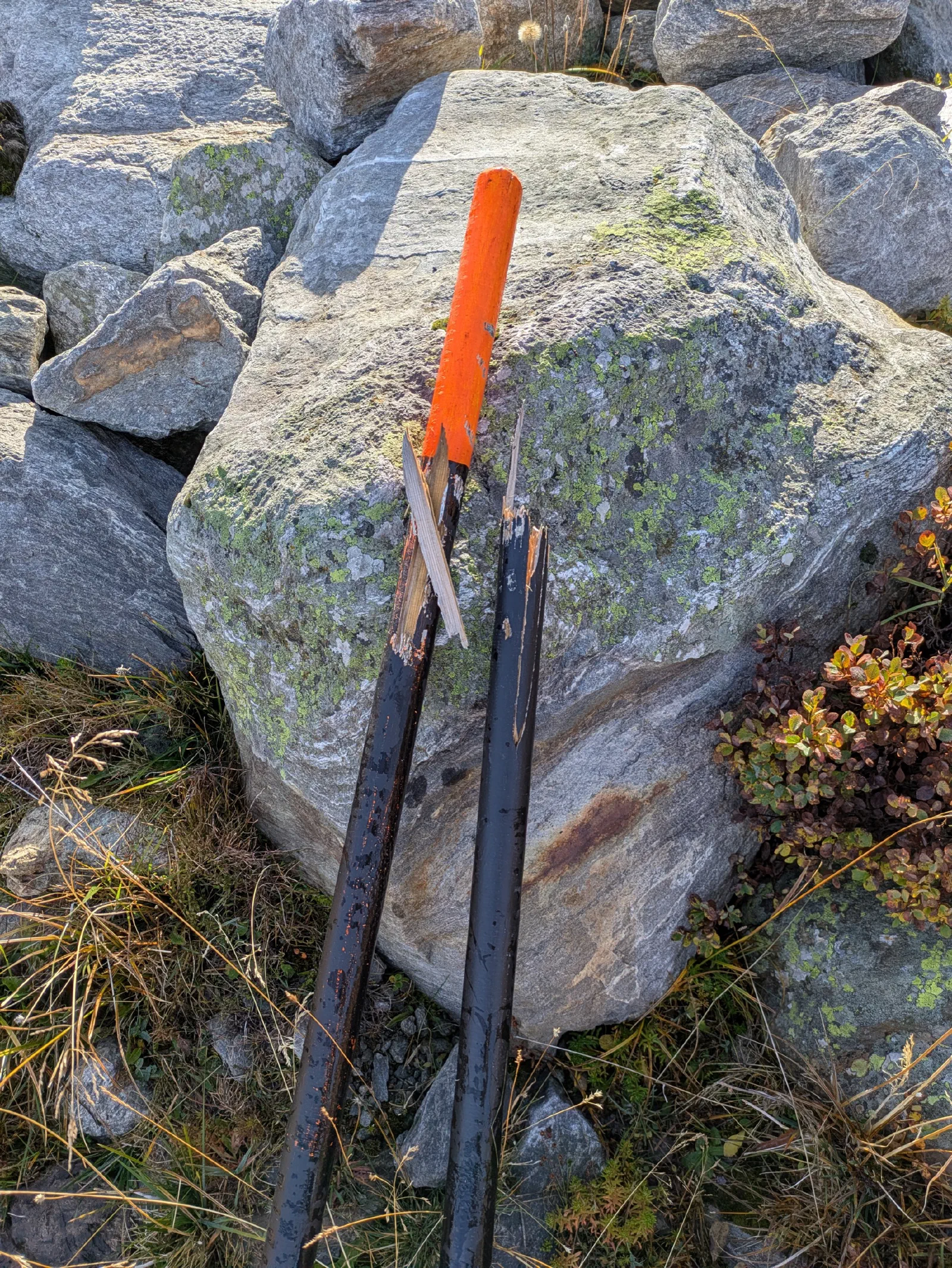 In August I went back to the scene of the crime and found the wooden post that I had flown
through. It may have fractured some ribs, but I think I won the fight.
Sitting in the hospital that afternoon, I thought, I’ve had my fair share of dislocated shoulders and bruised ribs before; I’ll be back in business in a few weeks. The recovery would be much longer and more difficult than I had imagined.
With such injuries, daily life quickly becomes a challenge. For those who have never dislocated a shoulder, healing usually starts from a position of “T-Rex arms”. That is, elbows pinned to your side, forearms in front of your torso (i.e., not rotated out). Reaching behind yourself or over shoulder level is impossible or extremely painful. Dealing with one is enough annoyance; this was my first experience having dislocated both. Luckily, I am pretty tall, so I was able to access my kitchen cabinets standing on tippy toes. There was one light switch in a bathroom that was over a sink and reaching out for it was really painful, so I just left the light on for like a week. But by far the most difficult thing each day was getting out of and back into bed. With my bruised or broken ribs, any time my core muscles engaged even slightly I got shooting pain throughout my entire chest. And I couldn’t reach my arms behind to push myself up. Go ahead and make your jokes: In the end I just fixed a rope to my bed so that I could pull myself up and lower myself down with my arms in front of me.
A week later I managed to get back on skis and climb up the trails at the ski resort, then took the cable car down as I could not risk another crash and my ribs couldn’t handle the vibration or core stability of skiing. As a pleasant surprise, though, climbing on skis was more comfortable than simple walking, as the gliding motion is less jarring. And it sure beat being on the couch 24/7. I had lost a ski pole in the accident and think that I earned some street cred with the Andermatt ski patrollers when I walked into their office to ask for it. “Du bist ein Sauhund!” (Literally “boar-hunting dog”; roughly, “real tough son of a —”.)
On several days I was convinced that my accident and injuries were just a dream and that the next day I’d wake up and everything would be normal again. But alas, no, I still needed that rope to get out of bed.
After some MRIs and CT scans and a few visits with doctors, they decided that they did not need to operate. There were two freed pieces of scapula, but they seemed to be healing themselves into what the orthopedic surgeon called “close enough” and not worth the risk of an operation. Relief turned to anxiety (what if operating is the right thing long-term?) turned to action (anxiety’s best antidote). There was a long road of physical therapy ahead of me, but I was on the healing path.
I started making new plans for the year. I realized that in all my years, I had never had a season-ending injury. The only thing comparable in terms of severity was an accident on my time trial bike in January 2013. I got a slow start to the year but ended up winning the mountain bike marathon national championship in Sun Valley that July. So my first idea was to make it not actually season-ending. Can I get a “win” in some form? I entered the last World Cup Vertical in Villars on 1 April, where I finished 45th of 49. I always thought it was a little cheesy when athletes talk about “just being on the starting line was a victory”; this was the first time in my life when I actually felt that.
But with that somewhat symbolic event participation aside, I turned my attention toward the summer and 2027 SkiMo season.
I split my summer into two halves, cycling and running (and no, I will not start swimming). I decided to target the Swiss time trial national championship in June. Time trials are shorter events, so they don’t require huge training volume, which wasn’t possible with the injury. And it would be a good shoulder mobility goal to be able to fit on a time trial bike. At this moment I could barely climb on a hometrainer and had to get a new stem that would bring my handlebars closer to me, so the idea of getting on a time trial bike seemed distant. From June to August, I decided to try some trail running events, mostly with an uphill focus. Last year I did well in a few vertical races but had still never done something with flat or downhill sections.
Something good can come out of any event, and in the case of this injury, it was tearing up my training script. My response to problems historically was, “train more”. I was doing this right up until my accident in February, when I had planned to “train more” through February in order to have a good March.
Finally, I learned to train smarter. I hired a nutritionist, which I thought would last a few months in order to make a few adjustments before moving on, but we hit it off and I hired her as my coach. Then I came across OYM, a training center nearby that was built for the EV Zug ice hockey team but also has athletes from other sports there. The primary focus is strength training, but they also have physical therapists and on-site lab testing (blood work, VO2 max, etc.). I liked the idea of having everything integrated, building a holistic plan to come back stronger.
My training now is completely different — fewer hours, much more strength training, interval sessions so short that historically I would not have even bothered to get dressed to do them. My strength and conditioning coach is always telling me “Enough, Joe, that’s good!” and I never feel destroyed after a training session (old me: was that even worth it?). But the results speak for themselves. Objectively: strength, power, VO2 max, and body composition are all going in the right direction. Subjectively: I feel the healthiest I ever have in my life.
Another surprise for me was how much I enjoy training with so many other people, both staff and athletes from other sports. I probably come close to maxing out the introvert scale, but being surrounded by people who take their sport seriously and excel at it breathes energy into me. Everyone has groggy days, and I believe the secret to success in sport is literally just showing up every day, even on the bad ones, and just walking into the building gives an energy boost.
In May, I had two final SkiMo races to do: the Armenian national championships in Vertical and Sprint. The events were held on spring snow in the backcountry far up a valley. We drove a truck full of athletes up a dirt road that in Switzerland would be a mountain bike trail, but it seemed like standard operating procedure there.
There weren’t enough skis for everyone, so they held the events in a time trial format. After finishing, athletes would ski down and give their skis to someone else. As the only person representing Armenia in the World Cup races, I did feel some pressure to win, which I did for both disciplines. After the winter I had had, it was a relief to deliver and put the skis away with a win.
The “road” leading to the SkiMo course. The back of this was loaded with probably about 20 people.
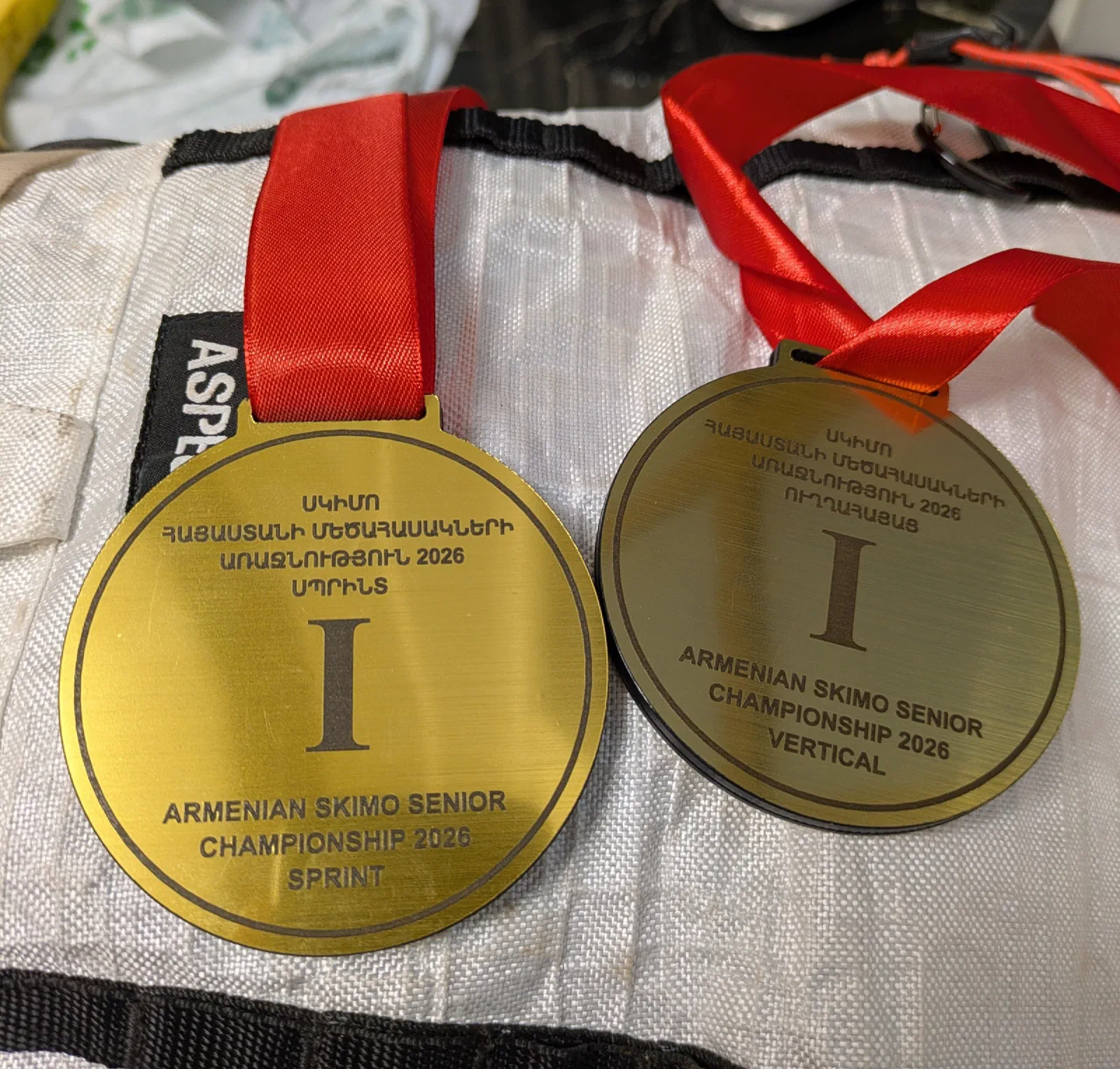 My two medals (not actual metal) from Armenian nationals.
Two weeks after the ski races, I was at a mountain bike race in a heat wave in the Jura Mountains. I did the first two stages but got sick and dropped out on stage three. My heart was not entirely in it anyway; I felt really uncomfortable on my mountain bike, worried that I would crash again and reinjure my shoulder(s). I did a few more mountain bike rides over the summer but then hung it up for the rest of the year.
Time trial nationals was a good goal at the time I set it, but as it approached I was already starting to look beyond it. I still showed up to compete, but I was thinking about 2027 SkiMo again and had slowly been introducing trail running into my training. Coincidentally, nationals were also in the Jura region and the heat wave had intensified. It was 38°C on the day of the race. I parked 5 km away in an underground garage to keep cool and not roast in the sun. My aerobars were still about 20 mm higher than my target position but I was mostly there. I had a somewhat embarrassing mechanical problem during the race, though: The bolt holding my Garmin on came loose and it fell off. That had never happened before and I have spent a lot of time on that bike. Quick mental math: lose 30–60 seconds, or lose a few hundred francs? I definitely wasn’t going to win, so I stopped to pick it up. I got last place. I was a little disappointed, but elite cycling is just on another level now and besides the injury, it has not been my focus. Onwards to running.
After my “bike season” was over I had plans to build into some short-distance trail running races. Like many cyclists, I have tried and given up on running several times. But first, why a second competitive sport on top of SkiMo anyway? One difficult aspect of SkiMo is that the season is so short. The season goes from about Christmas until early April (Armenian nationals in May aside). The road cycling season goes from February until October, so you are racing for most of the year. Mentally, I just cannot go eight months out of competition. I feel like some people are good at training, but I always had trouble finding my limits in training. I will always find that little bit extra in a race that I cannot find in training. For me, racing is important to stay sharp, see where your strengths and weaknesses are relative to others, and find your limits. Plus, it is just fun.
So I decided, for the fourth or fifth time in my life, that I would get into running. This time, though, it seems to have stuck. I actually started to enjoy it and look forward to the races. Perhaps it was a few good results, the friendlier atmosphere around trail running, or finally learning a little technique. Pacing in these races is a real challenge. I still have the cyclist’s mentality of not letting a gap open, but without drafting or coasting on downhills, starting too hard or not eating or drinking enough become expensive mistakes.
I had a funny experience at Sierre-Zinal. I stayed the night before the race at a hotel in Zinal and took the bus down to the start and sat next to a woman from Nantes. She told me about the first time that she had done the race and how she ran into an old friend at the finish. “Maybe you’ll run into an old friend too,” she said when we got off the bus. It was a funny remark; there are over 3,000 people competing there.
The race itself did not go particularly well for me. I started way too hard, constantly fighting for position on the opening climb. With such a large group it is taunting you to keep up with people ahead. I was on my target pace halfway through but could tell that I was in trouble. On flat and downhill sections my legs felt stiff and slow, and I was running 30–60 seconds per kilometer slower than normal. In a 33 km race, that adds up, and the final steep descent into Zinal sealed my fate: I ended up finishing 20 minutes behind my objective. I hopped in the car and drove home, reflecting on the course and how I should better approach something like that. Once home, I was scrolling through the results sheet, and saw just a few places ahead of me, “🇺🇸 Daniel Crespo”. No way. We were cycling teammates back in Colorado, last together probably circa 2013 or 2014. Google remembers everything, though, so I emailed him, “Hey man, was this really you?” And it was. Small world, and quite the premonition from my friend from Nantes.
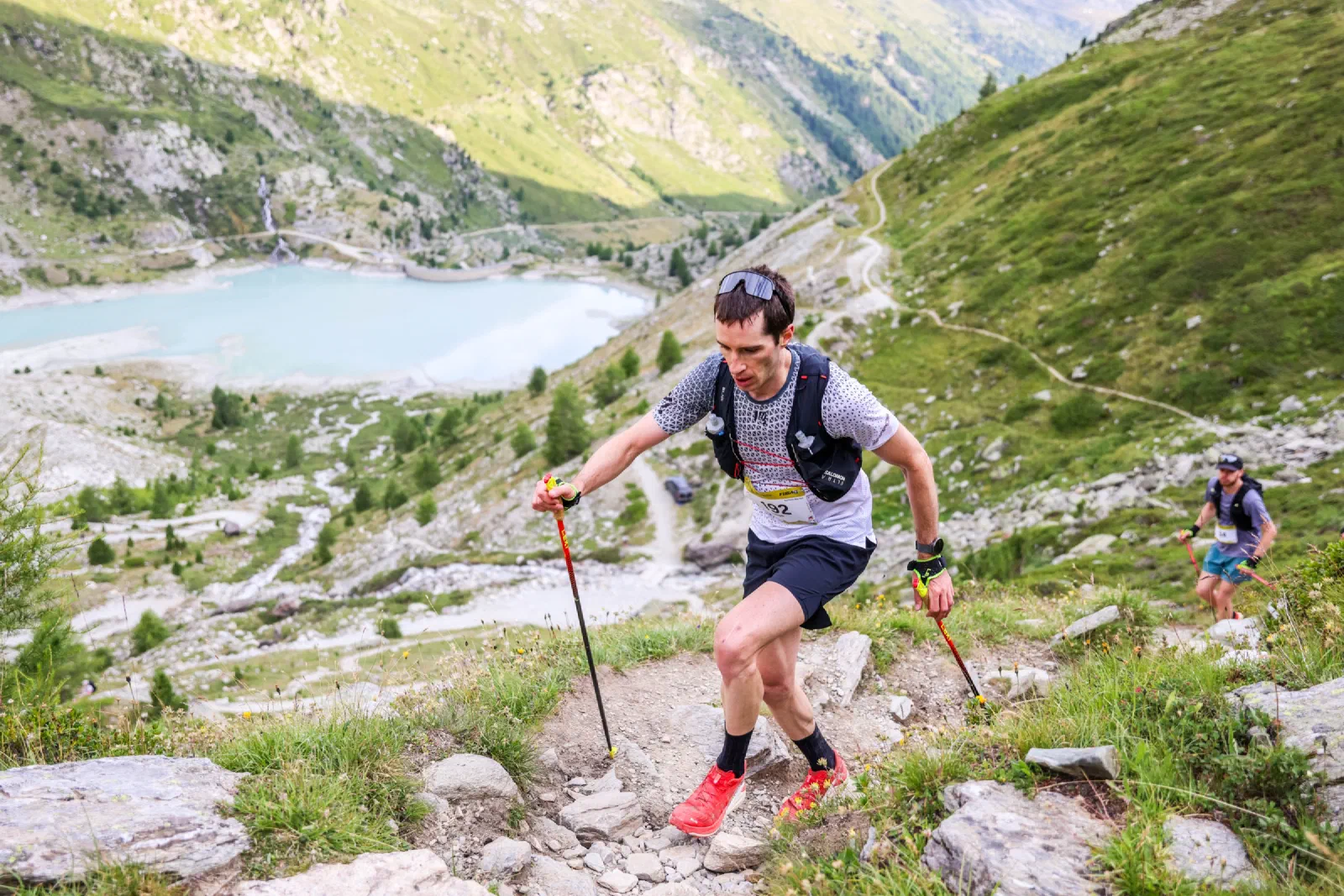 A photo of me from the triple-VK up the Barrhorn. 24 km and 3,100 meters of elevation gain. I
wanted a good result at this race but it drew a very strong field this year, and I only
managed 12th.
After one last race in Zermatt, the Ultraks 32 km, I flew to Tanzania to climb Kilimanjaro and do a little mountain biking there (made an exception). I was hoping that most of the mountain was rideable, but it was a bit too steep and was mostly hike-a-bike. But the way down was a blast, highly recommended over walking down.
My trip to Aconcagua in December had taught me a lot. I don’t have much to say about Kilimanjaro itself, because after Aconcagua it was downright easy. A few funny stories, though:
Before starting the hike, I asked the organizer to confirm that I had a tent. “That was the plan, but we upgraded you to one of the cabins in Horombo camp,” he said. I had learned my lesson on Aconcagua. The tent is your home. “Oh no, please downgrade me to a tent.” Once we were in the camp, I made friends with some other people who were complaining about how drafty the cabins were and that any time someone else got up the whole building creaked. I was happily in my tent, alone, quiet, and draft-free.
(For some history, my climbing partner, Christoph, and I had a long tent vs. cabin discussion before we climbed Aconcagua. I was fully on team cabin — less to bring, ostensibly more comfortable. Christoph has lots of experience climbing high mountains in Nepal and Pakistan and was a strong team tent advocate. Eventually I caved, but on the trip I saw how right he had been and I was brought over to team tent. On Kilimanjaro I gloated a little in this decision and how happy I was during the trip.)
On the day that I summited, I went from the second of three camps to the summit. From the third camp it is quite steep and loose, so I left my mountain bike with the park rangers at the third camp. I showed up around 9 a.m. and said that I’d be back in three to four hours. The lead ranger kind of rolled his eyes and said, “Sure.” He didn’t say the rest out loud, but he was certainly thinking, well there’s another tourist we will have to rescue later. It took me about two hours to reach the summit, where there was one other climber and his guide, on their way down. They took a picture for me and then left me alone on a perfect day — sunny, zero wind, and wearing just a long-sleeve shirt at 5,895 meters. I’m not one to linger on summits; after a few pictures I started down, thinking about the first shower I’d have in five days when I got back to the hotel. It took less than an hour to get back to the third camp (when it is steep and loose you can essentially ski down). The rangers all thought this was quite funny and said that most people take 10 hours just to go from camp three to the summit. From camp three it is a really fun mountain bike ride back down. There is a long stretch where you can just cruise at 40 kph across the desert. Sure beat walking.
One thing I did not plan to do was a safari. Several people had recommended it to me, but it felt a bit too touristy to me. After the climb, I still had a few days in Moshi before my flight out. I hired a driver to take me to Voi, Kenya, and back. From the road I saw a giraffe, a zebra, some impalas, and some camels. I had instant safari FOMO. Next time I find myself in Africa, I will definitely make time for it. Seeing those animals in the wild had a bigger impact on me than I would have expected; there is just something majestic about them.
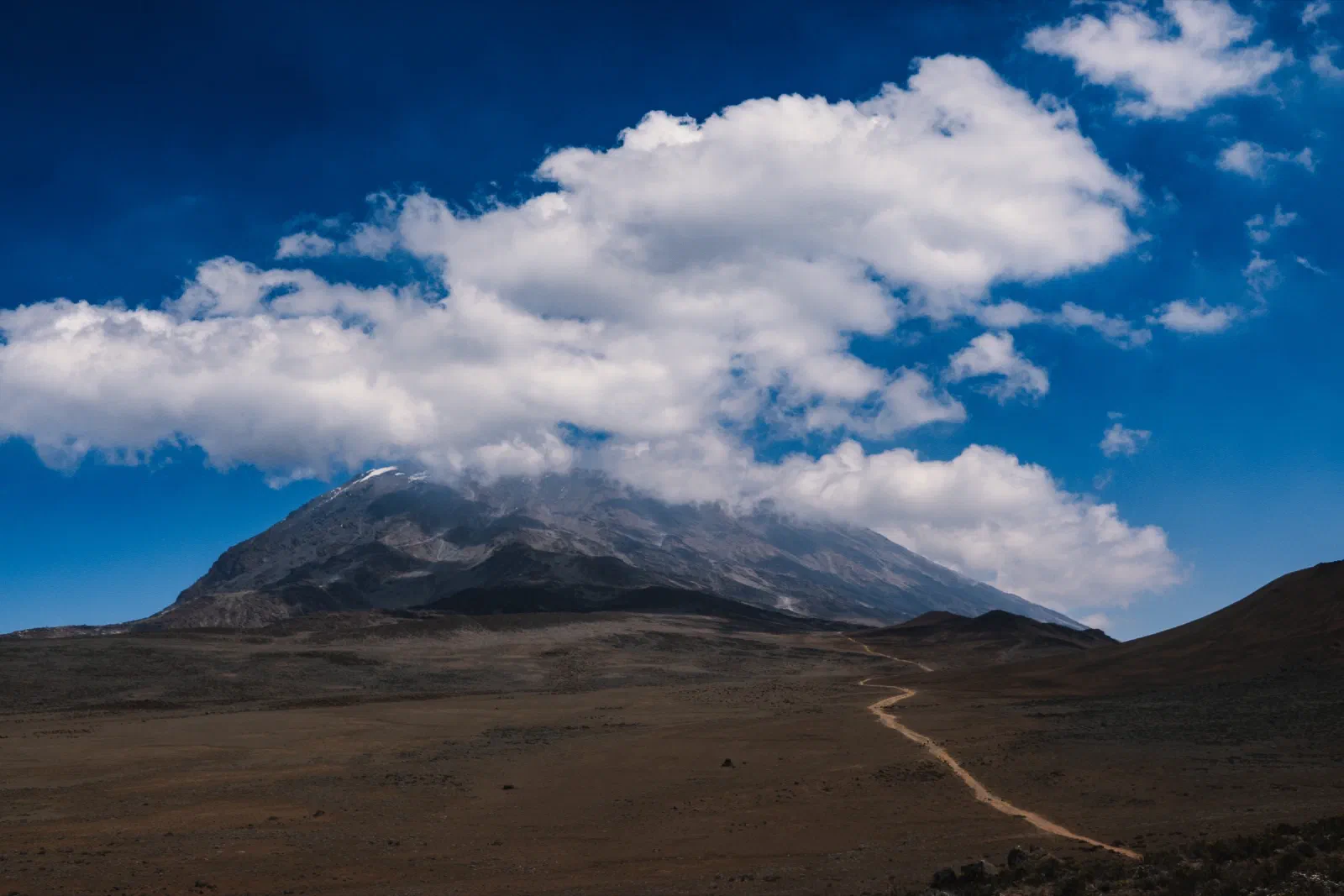 The approach to the Kilimanjaro summit. This was a lot of fun to ride down on the mountain bike.
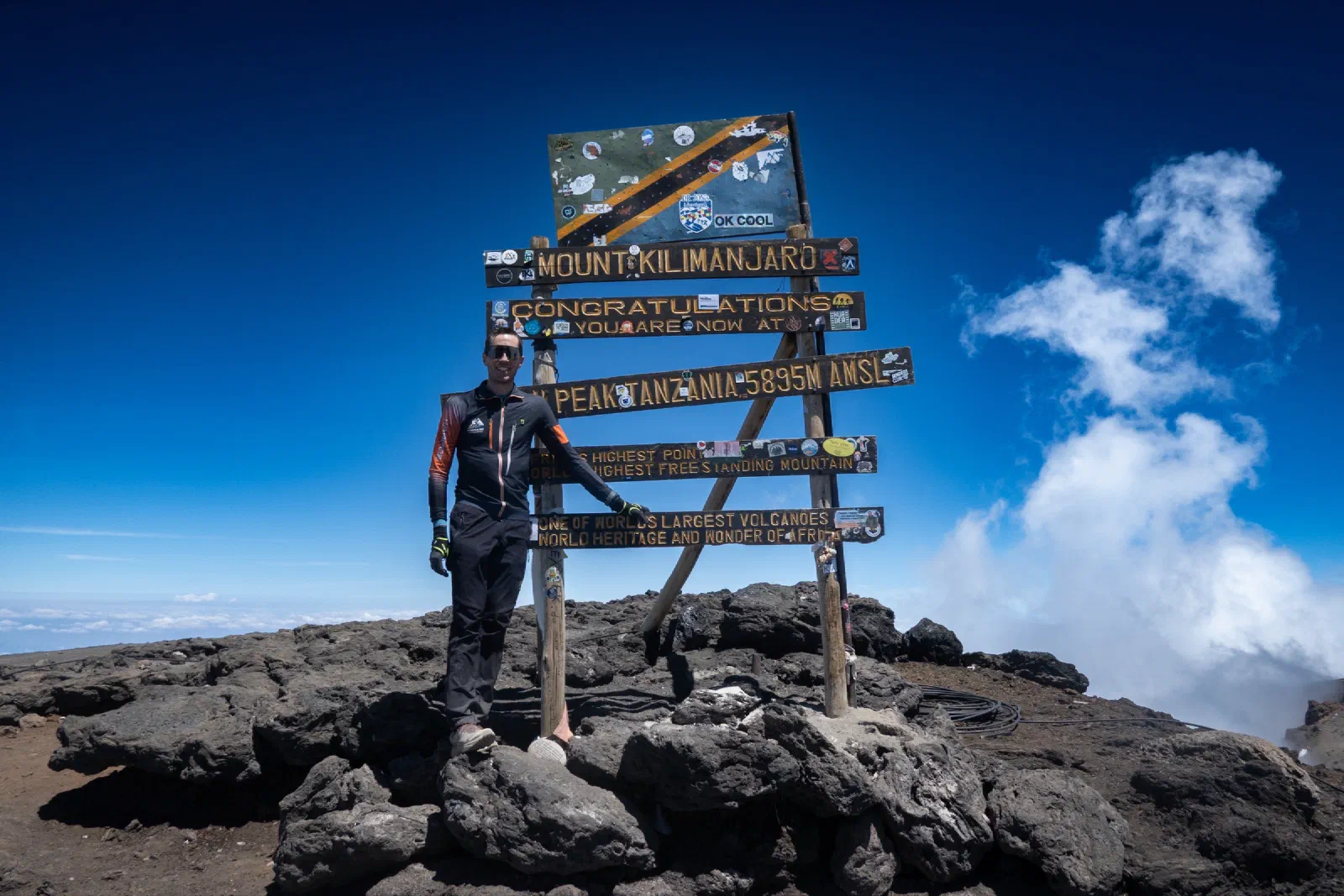 Summit day on Kilimanjaro.
Now, in November, I’m in a final training block before my racing season starts in January. As much as I enjoy adventure and traveling (even short trips to races in Switzerland), I love being at home too. I ebb and flow between traveler and homebody throughout a year — three to four months of one race after another, then three to four months at home with a daily routine and time to read extra books or indulge in some TV series.
From January to April, I will be on the road a lot going to the World Cup ski races. I hope that I will have something better to write next year than a broken scapula in February. I have considered why I continue with competition and what brought me back to it after so many years out of the game. When I was cycling, I was results-obsessed. But now I know where I stand and that my athletic potential is mostly tapped — as in, there’s not much room for improvement and there are other people I will just never beat in a race.
But there is something about participating at the highest level of a sport that seems worthwhile. I love being around people who are world-class in their discipline. The sport is growing — quickly since it was added to the Olympics — and simply participating in that growth fulfills something.
I titled this post “A Rebuilding Year”. Part of that was the physical rebuilding of my shoulder and what it can do. Another part was reevaluating my goals, realizing that I was trying to do too many things, and being more deliberate. I also rebuilt how I pursue those goals, with a completely new approach to training.
But there is one more thing I rebuilt (or am rebuilding), and it doesn’t exactly weave in chronologically like the rest of the post: that is, my relationship with America.
Four years ago I renounced my American citizenship. Coincidentally, it was at the U.S. Embassy in Yerevan and only two days after taking the exam for Armenian citizenship.
I went through a lot of phases over the six years leading up to the decision. After renouncing, people who find out usually ask, “Because of Trump?” or “Because of taxes?” No and no. While I did go through phases of grumbling about excessive U.S. meddling in the world, I also knew that nobody in the State Department was going to think, “This guy Joe just renounced his citizenship; we better rethink our foreign policy.” And the extra taxes were annoying the way that extra taxes would be. But I have always placed a huge value on where I live. Being able to walk out my front door and be in beautiful places by bike or on skis is more precious to me than any amount of money.
And although I like to think that a citizenship is just a construct, a piece of paper that says you can live in certain places, visit certain places without a visa, and have certain rights and obligations, it’s a construct that does form part of our identity. When I am in remote places, like on Kilimanjaro, and hear Americans talking (you always can), I know that we have something in common, that I can go talk to them and they will be friendly and welcoming.
The decision ultimately came down to the question: Do I want to live in America?
Another former American told me (to the best of my memory), “You are still the same person. You still have your childhood, your accent, the books and movies you like, your education, your perspective. You just walk into an embassy with a little blue book and walk out without it.”
I had realized as early as 2016 that if you don’t want to live in America, being an American citizen can be a huge pain. America may be the land of opportunity (and I believe it largely is), but being American outside of America can limit opportunity. Certain companies won’t hire you (extra regulations), and this limits your freedom to work with the companies you want to. The U.S. tax paperwork (not talking about the money here) is borderline obscene (my Swiss tax return is about 15 pages, U.S.: 108). I don’t know how many weekends I spent in the spring of each year collecting data and checking paperwork.
As I moved around Europe — from the U.K. to Normandy to Nice to Berlin and finally to Switzerland — I had all this in my mind but didn’t act on it until I had lived in Switzerland for two years. That is, for several years I felt confident about not moving back to America, but when I tried to visualize actually renouncing, I got knots in my stomach. When I moved to Switzerland, I instantly knew, this is home now.1 That was the moment that I felt truly comfortable with the decision. Still, I lingered on it for about 18 months before finally doing it. Walking out of the embassy in Yerevan, I really did feel like myself, just without that blue book.
I write about this now because I have followed U.S. politics more closely over the past year and feel more proud to be American (so to speak) than I have in a long time. The reaction to Trump — not just in the midterm elections but also to the sheer volume of unacceptable behavior and destruction over the last two years — has been inspirational to see. It feels kitschy to reference a Netflix documentary here, but there was a series called The American Experiment, and the word that they kept using was “aspirational”; despite the stains of the past like slavery and Japanese internment, the U.S. is always trying to become better. It may not be the country where I want to live, but when people assume that I am American, this is the quality that I do hope comes to mind for them.
Last year I was doing some communications coaching2 and after rambling for about five minutes about how I felt like I had multiple unconnected threads in my life — from my day job as an engineer to my ambitions in sport — my coach, Andrew, stopped me and said, “You want the freedom to create the life you want to live.” I love this and think of it often. Sometimes I look to replace the word “freedom”, as this can mean about a thousand different things.3 But I love this because of the word “create”; it implies that it takes work, that it’s not given to you, that it has accountability and trade-offs (like not being able to live in the U.S.), and that ultimately the creative process itself is rewarding.
The year has come full circle since that trip to Aconcagua. Today was my first day back on skis for the winter and in January the World Cup season will be in full swing. Physically stronger and more secure in my priorities and values than ever before, I hope that this year will be a foundation for the next several years to build on.
I am about to hit the six-year mark of living in my apartment. It is an odd realization, but since my family moved in middle school and then my parents moved while I was in university, this is the longest I’ve lived in the same home since elementary school. ↩︎
With One Real Voice; Andrew is awesome and I highly recommend it. ↩︎
Please go read my favorite book, “On Freedom”, by Maggie Nelson. ↩︎